© Official Site Of 555th Parachute Infantry “Triple Nickle”. 2008
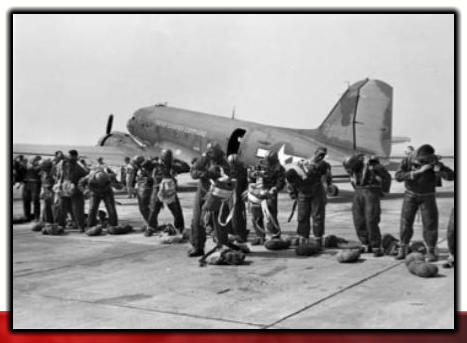





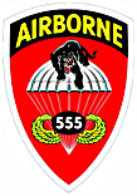
The 555
th
Parachute Infantry Battalion was nicknamed the "Triple Nickles" because of its numerical designation and the
selection of 17 of the original 20-member "colored test platoon" from the 92nd Infantry (Buffalo) Division. Hence, the origin
of the term Buffalo Nickles; the spelling derives from old English. Three buffalo nickels joined in a triangle or pyramid is
the identifying symbol.
Many years before “Black Pride" became a popular slogan, a small group of Black American soldiers gave life and
meaning to those words. Born within an army that had traditionally relegated Blacks to menial jobs and programmed
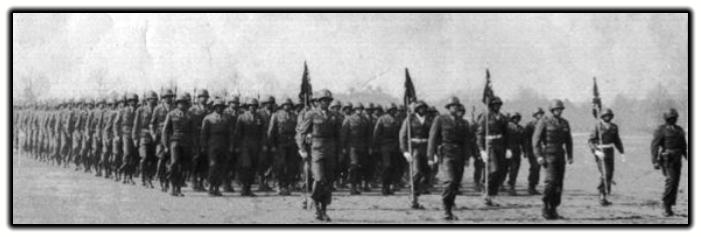
them for failure, the 555th Parachute Infantry Battalion, or "Triple Nickles," succeeded in becoming the nation's first All-
Black parachute infantry test platoon, company, and battalion.
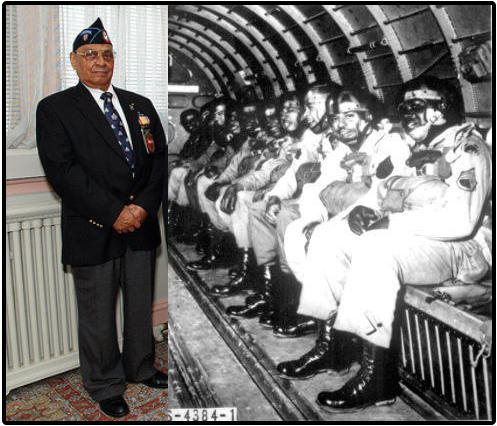
In the frosty Georgia winter of 1943-44, soldiers and officer candidates traveling to and from Fort Benning often saw the
sky filled with white parachutes. Most of them assumed that the faces beneath the chutes were also white. The black
soldiers they knew drove their trucks, waited on them in mess halls, or hauled their ammunition; they rode in the back of
the bus to and from Columbus; they gathered at their own separate clubs on the fort.
Some of the faces beneath those chutes, however, were black. As such they were also pioneers, blazing new trails for
countless black soldiers to follow. It wasn't easy. A proud black lieutenant, sergeant, or private, with polished boots and
paratrooper wings, still had to use the "colored" toilets and drinking fountains in the rail-road stations, sit in segregated
sections of theatres, and go out of his way to avoid confrontations with racist police.
Black officers continued to find post officers' club closed to them. But they endured, and proved themselves as airborne
troopers--"as fine a group of soldiers as I have ever seen," in the words of the notoriously fussy General Ben Lear.
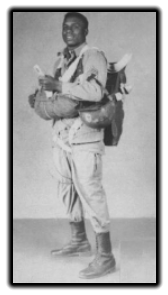
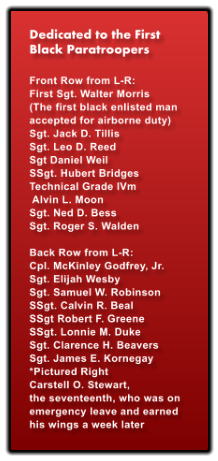
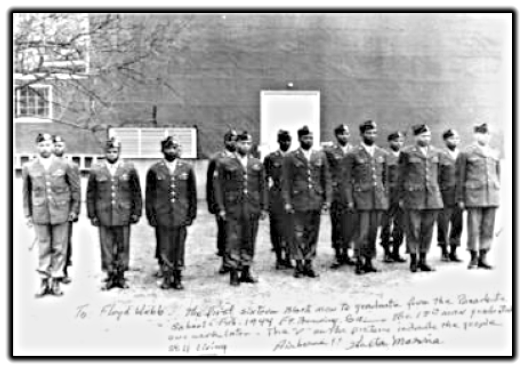


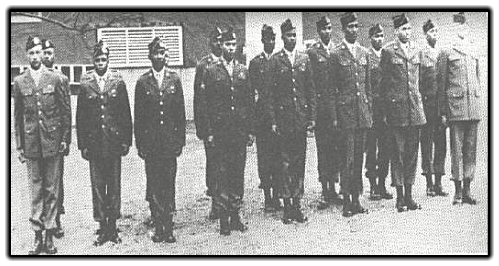
These Black pioneers were exceptional men, specially selected for the task. They were former university students and
professional athletes, top-notch and veteran non-coms. A major element in their success was that, unlike other Black
infantry units officered by Whites, they were entirely Black, from commanding officer down to the newest private.
In fathering the 3rd Battalion, 505th Airborne Infantry Regiment, the 80th Airborne Anti-aircraft Battalion, the 503rd
Airborne Artillery Battalion, and the 2nd Airborne Ranger Company, and serving in the 82nd, 101st, 11th and 13th Airborne
Divisions, the 187th Airborne Regimental Combat Team, the 188th and 511th Airborne Infantry Regiments, the Airborne
Center and Special Forces, the Triple Nickles served in more airborne units, in peace and war, than any other parachute
group in history.
Though combat-ready and alerted for European duty in late 1944, the changing tides of the war resulted in a different
assignment--jumping over the blazing forests of the American Northwest searching for Japanese balloon bombs, a job
requiring exact skills and special courage.
In this unusual role, the 555th also confronted a new dimension in warfare involving the use of biological agents that could
destroy woodlands and crops, but not humans. These men soon became known as the. . . . . . . “SmokeJumpers”
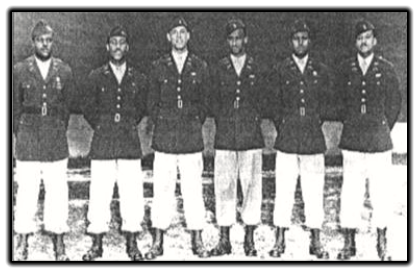
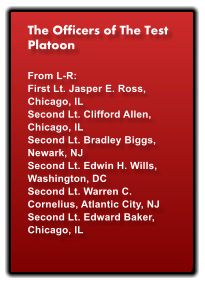
The first test platoon consisted of 17 fully qualified Black paratroopers in
February 1944. The seventeenth man, CPL Carstell O. Stewart, missed the
graduation picture because of an emergency leave.
In early 1945 the "Triple Nickles" received secret orders for a permanent change of station. They were sent to Pendleton,
Oregon & assigned to the 9th Services Command, trained by the U.S. Forest Service, and became history's first military
smokejumpers.
There were two reasons for this assignment, the first being that major commanders in Europe were leery of having highly
trained colored paratroopers coming into contact with racist white elements of the time. There were two reasons for this
assignment, the first being that major commanders in Europe were leery of having highly trained colored paratroopers
coming into contact with racist white elements of the time.
Second, the Japanese were at the time floating incendiary devices attached to balloons across the Pacific Ocean, taking
advantage of the jet stream's easterly flow, in an attempt to start forest fires in the northwestern United States. The Forest
Service asked the military for help and the “Triple Nickle” was ready, willing and able. The battalion answered some 36 fire
calls with more than 1,200 individual jumps during the summer of 1945, operating from Pendleton and Chico, Calif. The
operation covered all of the north-western states including Montana.
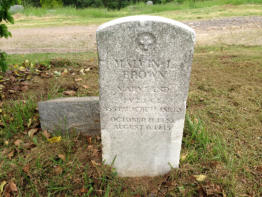
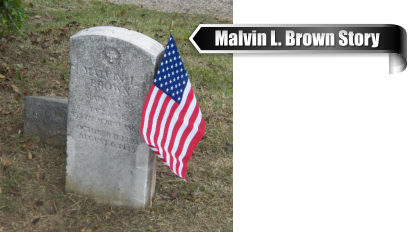
During fire operations the battalion suffered numerous injuries but only one fatality. Malvin L. Brown, a medic assigned to
the battalion's headquarters company, died on Aug.6, 1945 after falling during a let-down from a tree in the Siskiyou
National Forest near Roseburg, Ore. His death is the first recorded smoke jumper fatality during a fire jump.

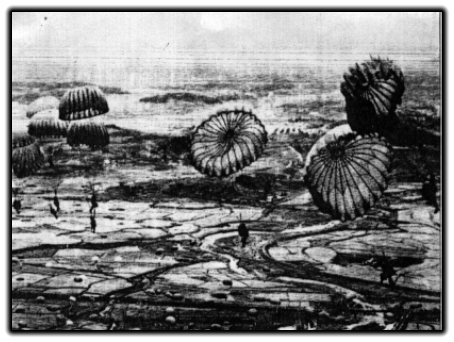
Munsan-ni, Korea, 23 March 1951. Heavily armed paratroopers and
rangers descend into the rice paddies during an airborne assault on
Good Friday morning.



































Click on Photo